

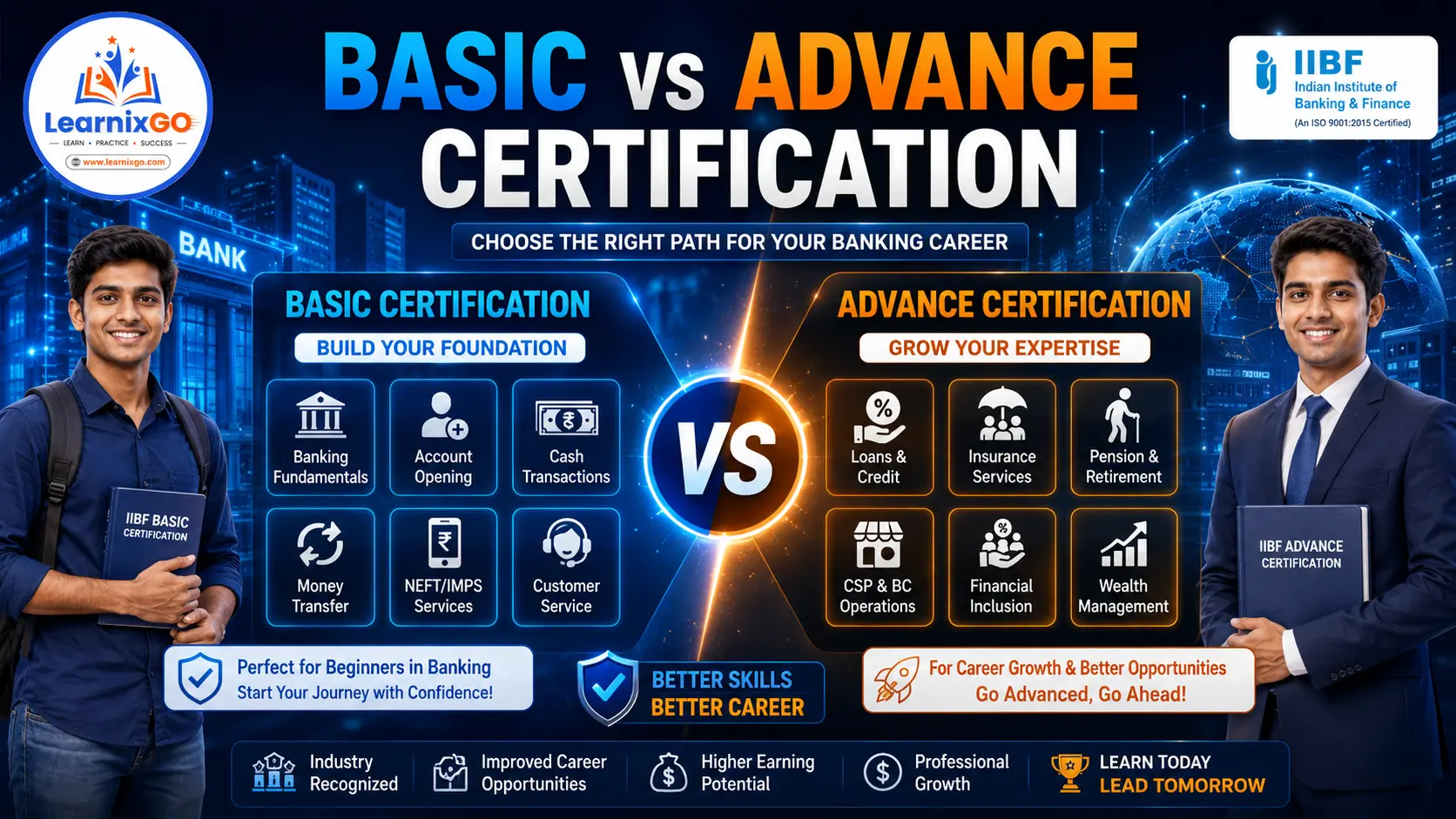
If you’re planning to become a Business Correspondent (BC) or Business Facilitator (BF), one of the most common questions is:
Should I choose the IIBF BC Basic Certification or the Advance Certification?
Many candidates believe that they must first pass the Basic Certification before appearing for the Advance Certification. However, this is not true.
In this comprehensive guide, we’ll compare IIBF BC Basic vs Advance Certification in terms of eligibility, training, fees, syllabus, exam pattern, career opportunities, and help you decide which certification is best for your career.
This article is based on the latest IIBF BC/BF Certification Guidelines.
What is IIBF BC Certification?
The Indian Institute of Banking & Finance (IIBF) offers the Business Correspondent (BC/BF) Certification to prepare candidates for delivering banking services through the Business Correspondent model.
The certification is available in two levels:
- Basic Certification
- Advance Certification
These are independent certifications, and candidates can choose either one based on their role and career goals.
What is IIBF BC Basic Certification?
The Basic Certification is designed for candidates who mainly provide basic banking services.
These services include:
- Cash Deposit
- Cash Withdrawal
- Money Transfer
- Remittance Services
- Payment Transactions
It is suitable for candidates working in entry-level BC operations.
What is IIBF BC Advance Certification?
The Advance Certification is designed for candidates who provide a wider range of banking services.
These include:
- Account Opening
- Cash Deposit
- Cash Withdrawal
- Loan Services
- Insurance Services
- Pension Products
- Financial Inclusion Activities
- Customer Service Point (CSP) Operations
The Advance Certification offers broader knowledge of banking operations and financial products.
IIBF BC Basic vs Advance Comparison
| Feature | Basic Certification | Advance Certification |
| Certification Level | Basic Level | Advanced Level |
| Training Duration | 28 Hours | 42 Hours |
| Minimum Training Days | 4 Days | 6 Days |
| Training Attendance | 75% | 75% |
| Exam Questions | 50 MCQs | 100 MCQs |
| Total Marks | 50 | 100 |
| Passing Marks | 25 | 50 |
| Exam Duration | 60 Minutes | 120 Minutes |
| Negative Marking | No | No |
| First Exam Fee | ₹400 + GST | ₹800 + GST |
| Re-Exam Fee | ₹300 + GST | ₹400 + GST |
Eligibility Criteria
The eligibility requirements are generally the same for both certifications.
Candidates should have:
- Minimum 10th Pass qualification
- Valid Mobile Number
- Valid Email Address
- Required Identity Documents
- Eligibility to work as a Business Correspondent
Is Basic Certification Mandatory Before Advance?
No.
According to the official IIBF guidelines:
Candidates can directly appear for the Advance Certification Examination.
Passing the Basic Certification is not mandatory before applying for the Advance Certification.
Training Comparison
Basic Certification Training
- Duration: 28 Hours
- Minimum: 4 Days
- Attendance Required: 75%
Advance Certification Training
- Duration: 42 Hours
- Minimum: 6 Days
- Attendance Required: 75%
After successful completion of training, candidates receive a Training ID, which is mandatory for exam registration.
Exam Pattern Comparison
Basic Certification
- 50 Multiple Choice Questions
- 60 Minutes
- 25 Passing Marks
- No Negative Marking
Advance Certification
- 100 Multiple Choice Questions
- 120 Minutes
- 50 Passing Marks
- No Negative Marking
Syllabus Comparison
Basic Certification Covers
- Financial Inclusion
- Banking Basics
- Customer Service
- Deposit Products
- KYC
- Digital Banking
- Government Schemes
Advance Certification Covers
Includes all Basic topics plus:
- Loan Products
- Insurance Products
- Pension Schemes
- Financial Literacy
- Banking Compliance
- Risk Management
- CSP Operations
- Customer Relationship Management
Fee Comparison
| Particular | Basic | Advance |
| Training Fee | ₹1,800 + GST | ₹2,700 + GST |
| First Exam Fee | ₹400 + GST | ₹800 + GST |
| Re-Exam Fee | ₹300 + GST | ₹400 + GST |
Career Opportunities
After Basic Certification
Suitable for:
- Cash Transactions
- Money Transfer Services
- Basic Banking Services
- Entry-Level BC Operations
After Advance Certification
Suitable for:
- Customer Service Point (CSP)
- Banking Correspondent Services
- Account Opening
- Loan Facilitation
- Insurance Services
- Pension Products
- Financial Inclusion Projects
Which Certification Should You Choose?
Choose Basic Certification If:
- You are new to banking.
- Your role involves only basic banking transactions.
- You want an entry-level BC certification.
Choose Advance Certification If:
- You want to provide complete banking services.
- You plan to operate a CSP.
- You want better career opportunities in banking and financial inclusion.
- You want comprehensive knowledge of banking products and services.
Frequently Asked Questions (FAQs)
Can I directly apply for the Advance Certification?
Yes. Candidates can directly appear for the Advance Certification Examination without completing the Basic Certification first.
Which certification is more beneficial?
The Advance Certification covers more banking services and offers broader career opportunities.
Is the syllabus the same?
No.
The Advance Certification includes all Basic topics along with additional subjects such as loans, insurance, pensions, compliance, and risk management.
Is the training different?
Yes.
Basic Training is 28 hours, while Advance Training is 42 hours.
Is there any negative marking?
No.
There is no negative marking in either examination.
Conclusion
Both IIBF BC Basic and Advance Certification are valuable qualifications for individuals working in the Business Correspondent ecosystem. The Basic Certification is ideal for candidates handling fundamental banking transactions, while the Advance Certification is designed for those who wish to provide a broader range of banking services, including account opening, loans, insurance, and CSP operations. Since Basic Certification is not a prerequisite for the Advance Certification, candidates should choose the certification that best aligns with their career goals and job responsibilities.